
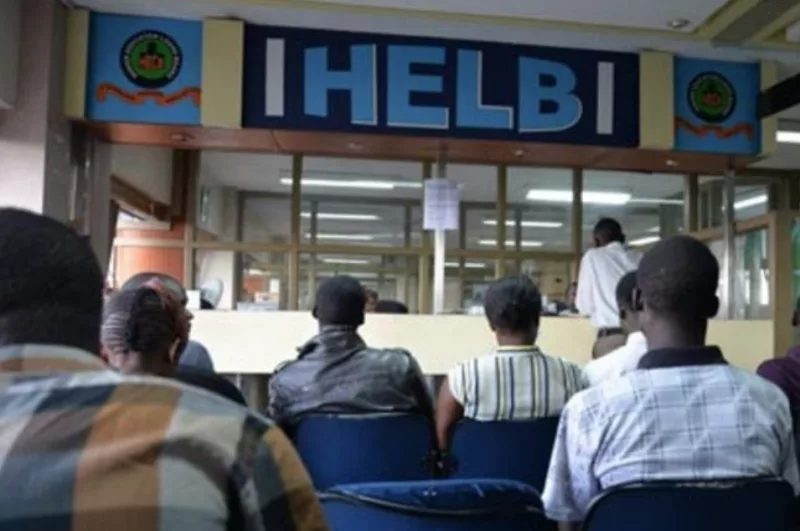
Experts say the needs-based funding model was built on a sound principle but undermined by weak implementation. University students wait to apply for loans at Helb headquarters in Nairobi. /FILE President William Ruto's proposal to replace Kenya's needs-based higher education funding model with universal funding has reignited debate over a system that was introduced just three years ago to make university financing fairer by directing more government support to the neediest students.
While the model was built on the principle of equity, education experts say its rollout was rushed, the tool used to assess students' financial needs was inadequately tested, and chronic underfunding ultimately undermined its success. Announcing the proposed reforms on Tuesday, Ruto said the government had abandoned confidence in the current funding model after concluding that it had failed to deliver the intended results. He also faulted the previous Differentiated Unit Cost (DUC) model, saying universities were left financially distressed after receiving far less funding than the government had committed.
The President said the government has forwarded amendments to Parliament seeking to introduce universal funding for all students placed in universities and Technical and Vocational Education and Training (TVET) institutions by the Kenya Universities and Colleges Central Placement Service (KUCCPS). He, however, did not indicate when the current model would be phased out, meaning the student-centred funding framework remains in force until Parliament approves the proposed changes. Parliamentary approval is necessary because the proposed reforms require amendments to the existing legal and policy framework governing higher education financing.
Any new funding model would also have to be reflected in future budget appropriations approved by lawmakers before public funds can be disbursed under the new system. The Higher Education Loans Board (HELB) has invited continuing students to submit subsequent loan applications for the 2026/2027 academic year, signalling that the current funding arrangements remain operational. "Apply quickly and conveniently through *642# and take the next step toward achieving your academic goals," The board said in a notice.
The student-centred, needs-based funding model was introduced in May 2023 for students joining universities and TVET institutions in the 2023/2024 academic year. It replaced the previous Differentiated Unit Cost (DUC) model, under which the government largely financed institutions through block funding regardless of individual students'financial circumstances. Under the current model, funding follows the student rather than the institution.
Each learner is assessed using a Means Testing Instrument (MTI), which analyses factors such as household income, family background and social circumstances before placing students into financial need bands ranging from the most vulnerable to the least needy. The assigned band determines the mix of government scholarships, HELB loans and household contribution required to finance a student's education. Combined government support through scholarships and loans ranges between 60 per cent and 95 per cent of the total programme cost, with families expected to contribute between 5 per cent and 40 per cent depending on the student's assessed level of need.
The objective was to ensure students from disadvantaged backgrounds received greater financial support while those deemed financially stable contributed a larger share of their fees. Education researcher and Usawa Agenda executive director Emmanuel Manyasa stated the model's biggest weakness was not its underlying principle but the way it was implemented. "It wasn't well thought out, that's just the bottom line.
It is a good idea but was not well thought out and it was rushed," He told on phone. According to Manyasa, the government deployed the Means Testing Instrument before sufficiently validating whether it could accurately determine every learner's financial circumstances. He argued that because the entire funding model depended on the credibility of the assessment tool, weaknesses in its design undermined confidence in the allocations from the outset.
Manyasa also faulted the government's assumption that changing the funding formula alone would solve universities'long-standing financial crisis." The bigger problem that the government is not resolving is enough funds, so whichever model of allocation, if insufficient funds are put in, the problem will still persist,"He stated. He questioned whether the proposed universal funding model would be financially sustainable, noting that public universities are still owed about Sh21 billion in unremitted government funds."
If you are unable to pay school fees for 10 children, how do you now say you will pay for 100?" He posed. His remarks were echoed by Rose, an educationist, who questioned where the additional resources would come from and whether HELB would continue operating under the proposed arrangement.
On the current model, she argued that inaccurate information supplied during the application process to some extend prevented assistance from reaching the students who needed it most." People are not genuine. When it comes to filling those forms, there was a lot of cheating.
Those who were needy could not get the help. Those who were in a position and were not needy were the ones who benefited,"She stated. Soon after the model was rolled out, students across several universities complained they had been placed in the wrong financial bands, with some vulnerable learners classified as financially stable and required to pay fees they could not afford.
Student leaders and education stakeholders argued that the Means Testing Instrument failed to accurately capture the financial realities of many households, locking out deserving learners from higher education. The rollout was also dogged by complaints over delayed upkeep loan disbursements, leaving many students struggling to pay for accommodation, food and other basic expenses. The dissatisfaction triggered demonstrations in several universities, with students demanding the model be scrapped.
The dispute eventually moved to court after student organisations and civil society groups challenged the model, arguing it had been introduced without adequate public participation and was discriminatory. In December 2024, the High Court agreed that the model had not met the constitutional threshold for public participation. Further concerns were raised by Auditor General Nancy Gathungu, whose audit identified weaknesses in the administration of higher education funding.
Her report found that HELB and the TVET department were not adequately coordinating student records, making it difficult to accurately track beneficiaries throughout their academic journey. The audit disclosed that some students received funding despite not being officially placed by KUCCPS, while others missed out because of missing or duplicated registration numbers. It further established that scholarships had been paid to students who had deferred their studies, failed to report to their institutions or had already been expelled."
As such, the effectiveness of control over scholarship management processes could not be confirmed,"The report stated. Even so, Manyasa maintains that fixing administrative shortcomings alone will not resolve the funding challenge unless the government commits adequate resources." It was wrong to assume that that model could resolve university funding problem.
It can't because universities' funding problems were not because of a model,"He stated. The bigger problem that the government is not resolving is enough funds, so whichever model of allocation, if insufficient funds are put in, the problem will still persist." His assessment suggests the debate over higher education financing is more about whether Kenya can sustainably finance whichever system it adopts and less about the model.
Help us continue bringing you unbiased news, in-depth investigations, and diverse perspectives. Your subscription keeps our mission alive and empowers us to provide high-quality, trustworthy journalism. Join us today to make a difference!